


Are Cheap Vehicle Rubber Floor Mats a Safety Hazard? What NHTSA Data Tells Us
Quick Answer
Can vehicle rubber floor mats be a safety hazard?
Yes — and here’s the documented evidence:
- NHTSA identified floor mat pedal entrapment as one of only two mechanical safety defects linked to unintended acceleration incidents in Toyota vehicles, triggering the recall of 3.8 million vehicles in October 2009.
- NHTSA confirmed that 5 individuals, in 2 separate incidents, died as a direct result of pedal entrapment caused by out-of-position or incompatible floor mats.
- Floor mat entrapment can occur when a mat is unsecured, when one mat is stacked on top of another, or when a mat not intended for that specific vehicle is used.
The solution isn’t complicated: a custom-fit, 3D/5D floor mat with OEM-compatible retainer clips, precision-moulded to your exact vehicle, eliminates all three of these risk conditions by design.
Most drivers never give their floor mats a second thought. They’re just something you walk on, right?
Wrong. A floor mat sitting unsecured or poorly fitted in your vehicle’s footwell is one of the most overlooked safety risks in modern driving — and it’s not a hypothetical. It’s a documented, government-investigated, recall-triggering hazard that has been linked to fatal crashes, multi-million dollar fines, and the recall of nearly 5 million vehicles worldwide.
If you’re driving with cheap, generic, or improperly installed vehicle rubber floor mats, this is something every driver needs to understand.
What Actually Happened – The NHTSA Floor Mat Safety Record
This isn’t theoretical. The floor mat pedal entrapment issue is one of the most extensively investigated vehicle safety topics in NHTSA’s history, with a documented trail of incidents, investigations, and recalls spanning more than a decade.
The Toyota Recalls – 3.8 Million Vehicles
In March 2007, NHTSA opened a preliminary investigation into pedal entrapment on Lexus ES350 models based on five consumer complaints alleging three crashes and seven injuries. The all-weather floor mat was identified as the possible cause.
In July 2007, a fatal crash occurred in San Jose, California involving a Toyota Camry — identified as being caused by a pedal trapped by an all-weather floor mat. In October 2009, Toyota recalled 3.8 million vehicles for pedal entrapment by floor mat and sent an interim letter to consumers instructing them to remove floor mats immediately.
Floor mat entrapment was determined to pose a high risk to human life and safety because an unsecured or incompatible mat can entrap the accelerator pedal, resulting in high-speed, uncontrolled acceleration.
The 2012 Lexus RX Recall and $17.35 Million Fine
The Toyota floor mat issue didn’t end with the 2009 recall. In early 2012, NHTSA’s Office of Defects Investigation began noticing a new trend in floor mat pedal entrapment in 2010 Lexus RX 350s. Toyota was aware of 63 alleged incidents of possible floor mat pedal entrapment — and in June 2012, Toyota conducted a recall of 154,036 Model Year 2010 Lexus RX 350 and RX 450h vehicles to address the issue.
Toyota subsequently agreed to pay $17.35 million to NHTSA to settle claims related to the timeliness of that recall — one of the largest automotive safety fines of its kind at the time.
It Wasn’t Just Toyota
The floor mat entrapment issue extends well beyond one manufacturer. In August 2012, Mercedes-Benz USA issued a separate NHTSA recall (Campaign Number 12E-028) covering 8,675 all-season floor mats for pedal entrapment risk.In 2013, Quadratec received an NHTSA recall (Campaign Number 13E-010) for floor liners in Jeep Wrangler models (2007–2013) after floor liner tearing was identified as a potential cause of pedal entrapment — affecting 15,836 units.
From 1960 to 2004, NHTSA undertook six floor mat pedal entrapment investigations out of a total of 4,789 defect probes. Today, a driver’s side floor mat retention device is found on virtually all vehicle models sold — a direct response to these documented safety incidents.
How Pedal Entrapment Actually Happens
Understanding the mechanism makes it easier to see why mat fit and retainer clips matter so much.
When pedal entrapment occurs, it often follows an acceleration event such as an overtaking manoeuvre or a merge onto a highway. Upon completion of the manoeuvre, when the driver releases the accelerator pedal, the pedal may be trapped due to interference caused by stacked or out-of-position floor mats — but it can also be caused by bunched or worn carpets or foreign objects in the driver footwell.
Even on recalled vehicles, entrapment by the mat can only occur if the floor mat is out of position because it is not secured, one floor mat is stacked on top of another floor mat, or a floor mat is used that is not intended for use in that specific vehicle.
This is precisely why three things matter above everything else when choosing vehicle rubber floor mats:
- Correct fit for your specific vehicle — a mat that is even slightly too large for your footwell will shift forward under braking. Generic or universal mats are the highest-risk category for this reason. Vehiclab’s 3D/5D all-weather floor mats are precision laser-measured to match every contour of your specific vehicle’s footwell to the millimetre.
- OEM-compatible retainer clips on the driver’s side — this is non-negotiable. Vehiclab’s driver-side mat is fitted with retainers compatible with your vehicle’s factory anchor points, preventing any forward movement under braking or acceleration.
- Never stack mats — removing your factory mats completely before installing new ones is an essential installation step, not optional. NHTSA’s safety advisory, issued to all drivers at the time of the Toyota recall, specifically warned of the serious dangers of not properly anchoring mats or stacking mats on top of each other. Vehiclab’s FAQ confirms the same: stacking a new liner on top of an existing factory mat raises the floor height and prevents retainer clips from engaging.
What Makes a Vehicle Rubber Floor Mat Safe
Now that the risk is clear, here’s what to look for when choosing a replacement set.
Precision Fit — The Single Most Important Factor
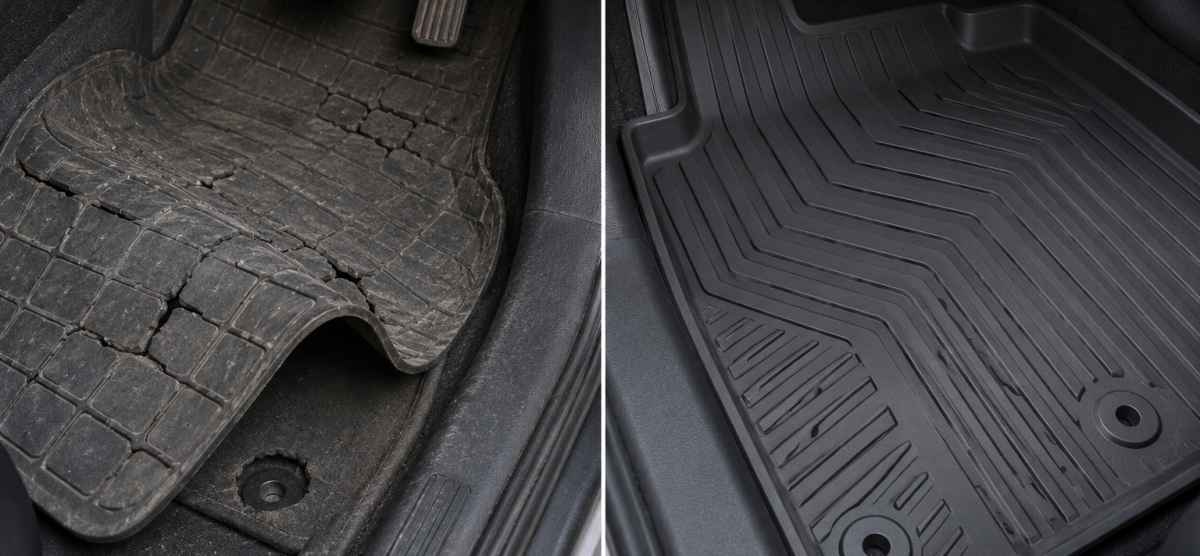
Universal rubber mats leave gaps around edges and near pedals — and can shift under the brake pedal, creating a genuine safety hazard that custom-fit mats eliminate entirely. A mat that is precision-moulded to your exact vehicle’s footwell geometry — not trimmed to fit, not approximate — sits flush and cannot creep forward toward the pedals.
TPE Over Traditional Rubber
As we explored in detail in our guide on vehicle rubber floor mats for Australian drivers, traditional rubber mats have a documented tendency to stiffen, curl, and lose their anti-slip backing over time — all conditions that increase the risk of mat movement in the footwell. Vehiclab’s TPE compound stays flexible across Australian temperature extremes, maintains its non-skid profile on both surfaces, and won’t curl at the edges regardless of season.
Non-Skid Backing and Retainer Compatibility
The underside of a floor mat matters as much as the top surface. A non-skid finish that degrades over time — common in lower-quality rubber mats — loses its grip against the carpet underneath, allowing the mat to slide. Vehiclab’s mats feature a permanent non-skid finish on both sides, and the driver-side mat engages your vehicle’s factory retainer hooks — the same system NHTSA identified as the correct standard for all vehicles after the Toyota recall investigations.
Protecting the Boot Too
Interior protection doesn’t stop at the footwells. If you’re loading tools, camping equipment, or groceries regularly, your boot takes daily punishment too. A precision-fit 3D/5D boot liner from Vehiclab uses the same raised-edge TPE design and custom-moulded fit — protecting your cargo carpet and completing your vehicle’s interior protection from front footwells to the boot.
As we covered in our previous blog on why Australians are upgrading their automobile mats in 2026 and our detailed breakdown of how long vehicle car mats should last, pairing quality floor mats with a matching boot liner is the most comprehensive interior protection decision you can make.
The Bottom Line
Cheap, generic, or improperly fitted vehicle rubber floor mats are not a minor inconvenience. The NHTSA has issued recalls and safety advisories specifically addressing floor mat-related incidents, including high-profile cases where unintended acceleration or brake failure was traced back to improper mat installation or use of non-OEM mats.
The fix is straightforward: choose a custom-fit mat precision-moulded for your exact vehicle, with OEM-compatible retainer clips, a permanent non-skid backing, and a material that won’t stiffen, curl, or degrade over time.
Vehiclab has been supplying right-hand drive Australian vehicles with precision-fit 3D/5D all-weather floor mats for 10+ years — with a 100% custom fit guarantee, 5-year Australian warranty, free delivery, same-day dispatch, and a 60-day return policy.
Frequently Asked Questions
Q1: Have cheap floor mats actually caused fatal accidents?
Yes. NHTSA confirmed 5 deaths across 2 separate incidents directly caused by floor mat pedal entrapment in improperly secured or incompatible mats.
Q2: What makes a floor mat cause pedal entrapment?
Entrapment occurs when a mat is unsecured, stacked on top of another mat, or not designed for that specific vehicle — allowing it to slide forward and obstruct pedal travel.
Q3: How many vehicles were recalled over floor mat pedal entrapment?
Toyota recalled 3.8 million vehicles in 2009 for floor mat pedal entrapment. A further 154,036 Lexus RX vehicles were recalled in 2012, resulting in a $17.35 million NHTSA fine for delayed action.
Q4: How do custom-fit floor mats prevent pedal entrapment?
Custom-fit mats are precision-moulded to your exact footwell with OEM retainer clips on the driver’s side — eliminating the gap, shift, and stacking conditions that NHTSA identified as the root causes of entrapment incidents.